
Assistive Listening Solutions for Colleges and Schools
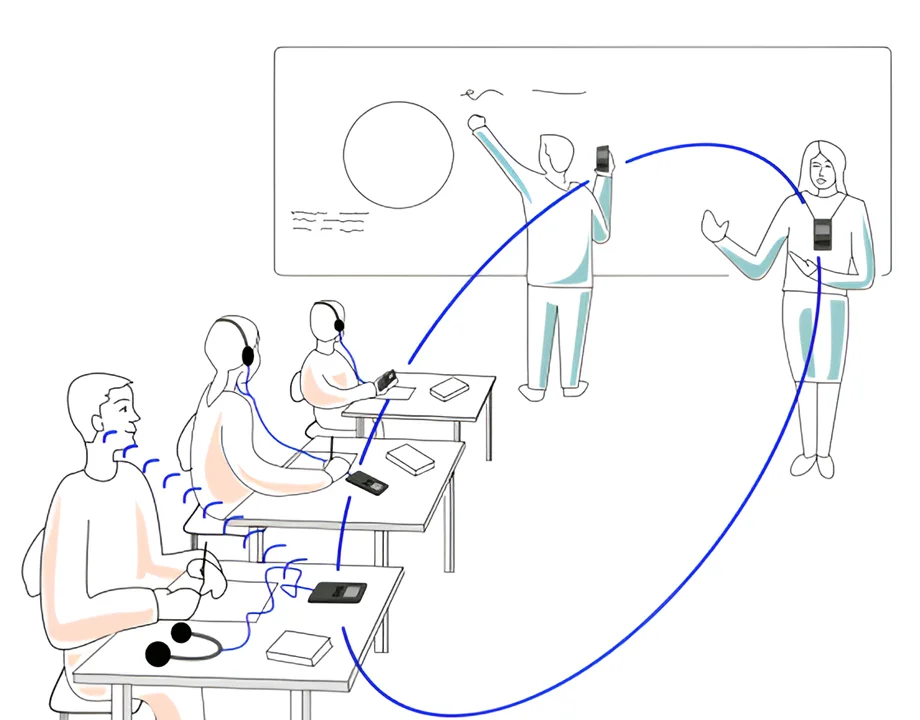
Almost 15 percent of children in the United States are diagnosed with some degree of hearing loss.
The Americans with Disabilities Act (ADA) and international laws on assistive listening set standards for what types of equipment are required. But beyond this, several studies have demonstrated the clear boost in educational outcomes that hearing-impaired students get with with right assistive technologies.
One academic study found that personal assistive listening equipment showed “significant improvement” in student outcomes compared to both hearing aids and speaker systems.
What accounts for this boost?
It has a lot to do with the unique acoustic challenges of schools and educational facilities. Papers shuffling, students talking, echoey auditoriums, and the myriad of other distracting sounds in the school environment tend to reduce the signal-to-noise ratio which is the single most important factor for auditory comprehension.
The issue for educators is that assistive listening is not a one-size-fits-all decision. It’s critical to tailor the right solution for the facility as a whole because some systems may not “play well” together or cause interference if configured incorrectly.
Our mission at Assistive Listening HQ is to match you with top-quality, ADA-approved assistive listening equipment so that all your students – regardless of hearing ability – can succeed. The article below suggests solutions for the most common types of educational facilities, including:
- A small-medium sized classroom (up to 30 listeners)
- A large classroom or lecture hall (over 30-75 listeners)
- Auditorium (75+ listeners)
- Outdoors
- Gymnasiums
- Multiple rooms linked by audio-visual equipment
For personalized help in configuring a custom solution for your school or university, please click the button below. We will send a free personalized quote.
Recommended Assistive Listening Systems for Schools
Infrared – IRT2 System
- Classrooms
- Small conference rooms
The IRT2 system is an infrared system, meaning it transmits the audio signal via invisible light beams. It comes with an infrared transmitter and matching neck-loop receivers. The speaker speaks into a microphone. This microphone connects to an infrared emitter that transmits the signal to students wearing neck-loop receivers.
The transmitter and receiver automatically connect as soon as they recognize each other (no need to “tune in” to a channel). The IR transmitter will cover the room as long as the students have a line of sight to the emitter. Some additional considerations for IR systems in educational settings are:
- The connection is seamless (no setup).
- Easy to install (no need to remodel structure)
- Transmission is private – the signal cannot penetrate through walls or other objects, so the signal stays in the room.
- IR is susceptible to line-of-sight interference. Once a person or object stands between the receiver and transmitter the link is broken. So it would not be ideal for classrooms with pillars, or physical barriers to line-of-sight.
FM Systems
- Medium to large classrooms
- Auditoriums
- Lecture halls
The FM transmitter integrates into the existing PA system. The broadcast signal can be picked up by a matching PPA receiver and headphones. As needed, the receivers are charged (or battery swapped) and wiped down with an alcohol pad. Some additional considerations for choosing FM systems in educational settings:
- Ideal for large venues (up to 1,000 ft range)
- Easy to install (no need to remodel structure)
- Integrates fully with existing sound systems
- Listeners can sit anywhere within range
- Cost-effective
- Works indoors, outdoors, and through ceilings
- Complies with 2010 ADA guidelines
- Users cannot use their listening device (eg smartphone); they typically use faculty-provided FM receivers
- FM signals can be subject to interference from other electronic equipment nearby and have a generally lower quality of audio signal than, for example, digital system
- The matched PPA receivers ensure clear audio reception for those with hearing challenges
Wi-Fi System (WaveCAST)
- Indoor/outdoor mixed use
- Auditoriums
- Gyms
Ideal for situations where listeners will bring their listening device (eg smartphone), the WaveCAST system from Williams Sound streams the audio signal in real-time to smartphones and tablets. The listener downloads the free WaveCAST application from the iOS or Android app stores and then automatically receives the WaveCAST transmission once connected to the school’s Wi-Fi network.
WaveCAST WIFI based also offers a more discreet Assisted Listening Solution as only those that are connected to the venue’s WIFI (which could be password protected) can ‘tune in’. What about users who do not have smartphones or do not want to download the app? WaveCast receivers are also available, so they can be provided to individuals who are not able to listen via the app. Additional considerations for Wi-Fi assistive listening systems in educational settings:
- Ideal for small to medium venues
- Easy to install
- Students download the listening app onto their devices and use their headphones.
- Integrates fully with existing sound systems
- Students can sit/be anywhere
- Cost-effective
- complies with 2010 ADA guidelines
- Digital audio processing settings for voice and music
- Wi-Fi router ranges are limited – so several routers may be required to cover the designated area.
- Each router will have a limited number of devices that can be connected at any one time.
FM / Wi-Fi Hybrid Solutions
Want the best of both worlds? The FM Plus system (coming in 2019) from Williams Sound is the world’s first hybrid transmitter able to broadcast FM and Wi-Fi audio simultaneously. With FM+, the customer gets both for little more than the cost of an FM-only solution.
Students listen with either an FM receiver or their smartphone using a free app downloaded from the App Store on iOS or Android. In addition to this flexibility, the FM Plus system offers exceptionally clear audio over both FM and Wi-Fi using onboard digital signal processing. More considerations for selecting hybrid systems in educational settings:
- Very high-quality audio (on-board digital signal processing)
- Listeners have the choice of using their own Wi-Fi device (such as a smartphone) or a school/college-provided FM receiver
- Easy to install (no need to retrofit facility)
- Students using the smartphone option will need to download and install an iOS or Android app
Hearing Loops / Induction Loops
large auditoriums, lecture halls, and theaters (not recommended for classrooms) A hearing loop (AKA an audio induction loop or telecoil system) is an assistive listening system for use in an auditorium or classroom where students with hearing aids that have ’T-coils’ are automatically ‘tuned in’. The sound is transmitted to the listeners/students through a cable that runs around the perimeter of the coverage area.
The hearing loop provides a wireless signal that is picked up by the T-coil-enabled hearing aid. Some other considerations for hearing loop systems in educational settings include:
- Cuts out unwanted background noise
- No need to use a receiver/headset ( for those with T-coil hearing aids)
- Sound goes directly to the t-coil-compatible hearing aid
- The hearing loop coil is hidden from view
- Unlimited number of users within the ‘loop zone’
- Requires a major renovation of the floor area to install (ideal for installation during a renovation).
- Not suitable for areas where many adjoining rooms are close together (due to signal bleed)
For personalized help with your questions or any comments just click the button below to receive a fast and free personalized quote.
Not Recommended for Educational Environments
- SoundField Systems.
These systems use speakers located in the ceiling to amplify the voice of the teacher/ presenter. Unfortunately, studies have shown that such systems do not improve educational outcomes to the same degree as systems that connect directly to the ear. This is due to the relatively high amount of background noise in school settings, which affects the signal-to-noise ratio.
Need help configuring custom Assistive Listening Solutions for Colleges, Schools, and classrooms? Click below for personalized assistance.
Where are Assistive Listening Systems Required?
Many countries require assistive listening systems to be provided in venues where audible communication is critical to using the space.
In the United States, these venues include classrooms, courtrooms, public meeting rooms, convention centers, and other public places.
Our compliance guides below will help you determine the exact requirements for your situation:

ADA Guide
Guide to assistive listening requirements under the Americans With Disabilities Act.

International Guide
Guide to hearing support requirements and legislation around the world, including the EU, and UK.
